Related Stories
Sheps Postdoctoral Fellow Highlights Gap in Integrated Diabetes Care
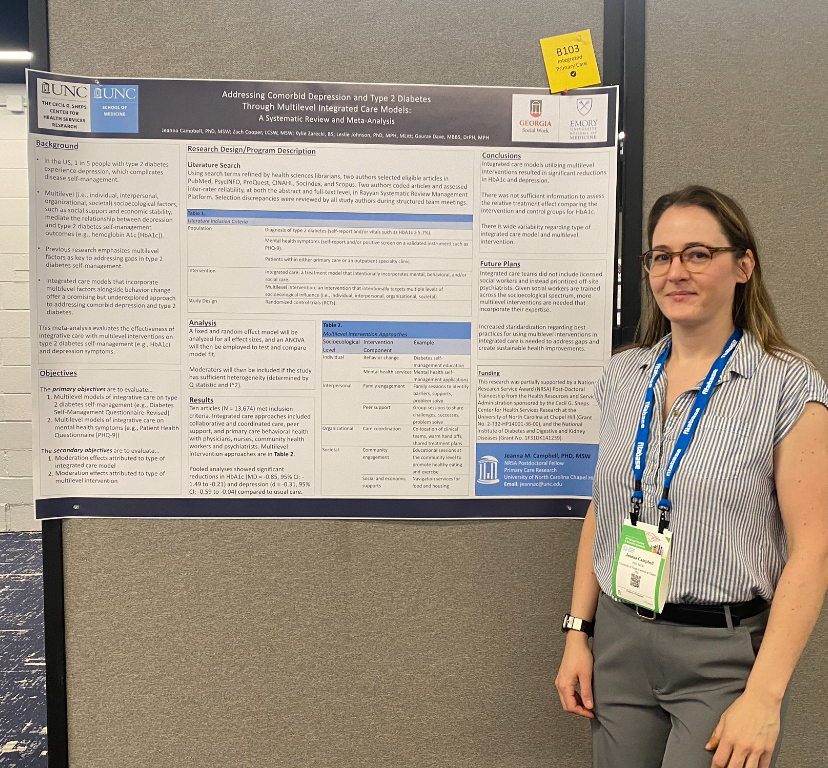 Jeanna Campbell, PhD, MSW is a second year National Research Service Award Postdoctoral Fellow in Primary Care Research and the first trained social worker to earn the fellowship with the Cecil G. Sheps Center. She developed an interest in social work and primary care from her experiences living in poverty with diabetes. Her team’s research, featured at the Society for Behavioral Medicine 47th Annual Meeting & Scientific Sessions in Chicago, IL, highlights how social workers are missing from integrated primary care teams that seek to address social determinants of health, such as poverty, and comorbid diabetes and depression.
In the United States, 1 in 5 people with diabetes experience depression, nearly two times higher than the general population. As an adverse social determinant of health, poverty further doubles the risk of depression, reduces access to diabetes management resources (e.g., health foods, glucose testing supplies), and worsens diabetes management outcomes such as hemoglobin A1c. The American Diabetes Association recommends integrating physical and psychosocial healthcare to address the negative effects of adverse social determinants of health on comorbid diabetes and depression. Integrated care teams are multidisciplinary, commonly including physicians, nurses, community health workers, and psychiatrists.
Integrated care multilevel interventions seek to address social determinants of health at multiple levels of the health ecology simultaneously (i.e., individual, interpersonal, organizational and/or community). While literature is limited, in meta-analysis Dr. Campbell’s team found that the 10 existing integrated care multilevel interventions significantly improved hemoglobin A1c (MD = -0.85, 95% CI: -1.49 to -0.21) and self-rated depressive symptoms (d = -0.31, 95% CI: -0.59 to -0.04) in comparison to usual care. The multilevel interventions commonly included individual and interpersonal components such as diabetes self-management education and family and peer support. Organizational and community level components included co-location of integrated care teams, shared treatment plans, community education to reduce stigma, and navigation services to directly link patients living in poverty to food and housing.
According to the Council on Social Work Education, the national association that represents social work education, social workers are trained to engage in assessment and intervention at all levels of the health ecology. They provide not only psychotherapy but also assess organizational and community level resources and advocate with and on behalf of patients with low income to improve well-being. However, Dr. Campbell’s team found that none of the integrated care multilevel interventions included the licensed expertise of social workers. More integrated care multilevel interventions are needed that leverage their multilevel expertise. Moreover, increased standardization regarding best practices for use of multilevel interventions in integrated care is needed to address gaps and create sustainable health improvements for low income communities.
Dr. Campbell wants to thank her team members for their contributions, including Zach Cooper, LCSW, CADC-II and Kylie Zarecki, BS from University of Georgia School of Social Work; Leslie Johnson PhD, MPH, MLitt from Emory University Department of Family and Preventive Medicine; and Gaurav Dave, MBBS, DrPH, MPH Professor of Medicine, Director for the Center for Thriving Communities, and Director for Abacus Evaluation at the University of North Carolina at Chapel Hill.
You must be logged in to post a comment.